 Dr Julia Martins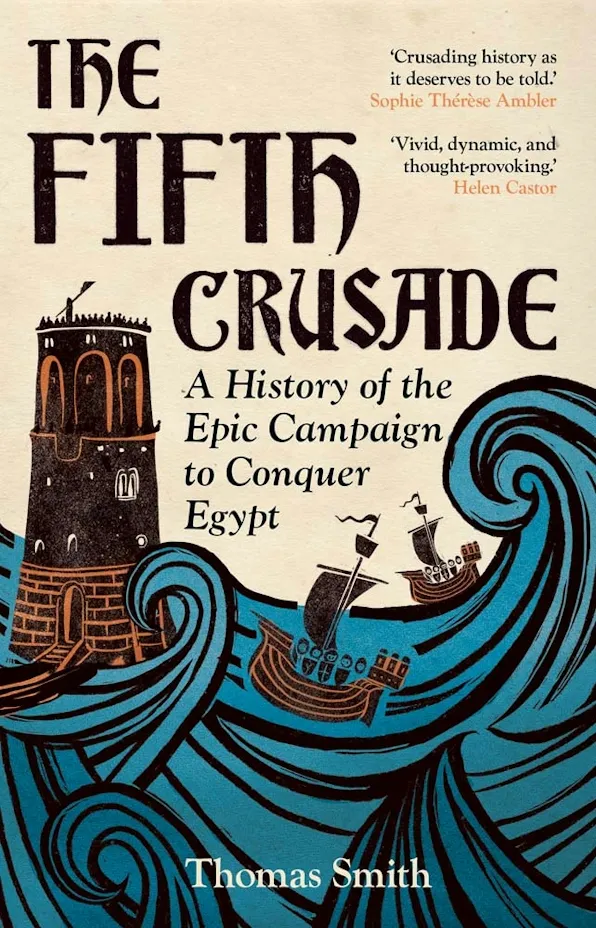
The first time I realised there might be more to learning about the Crusades than what I had been taught at school was through my French teacher, Monsieur Roche. He had us read and discuss passages of Les Croisades vues par les Arabes (The Crusades Through Arab Eyes), by Amin Maalouf, and my teenage mind was blown. Maalouf relied on Muslim historians and chroniclers to tell a different story than what I had studied. I had never thought about how the Crusades may have been experienced by those who were being invaded; I had only been taught the point of view of the invaders.
That may sound naive in hindsight, but this was not a problem relegated to teenage wannabe historians like me. Much has changed since Maalouf’s groundbreaking 1983 study. Historians today are more careful, perhaps, to acknowledge our own blind spots, and more inclined to ask different questions, including whose voices get left out of narratives, and why. I think that makes for much more interesting history.
Nowadays, when I think of the Crusades, my mind tends to wander to the edges: the women left behind and those who joined the crusaders, the healers who followed the armies, the convergences between Christian and Islamic medicine. I am not, by training or inclination, a military historian. And yet there is something about crusading history that keeps pulling me back. Perhaps it is the sheer improbability of it all; the idea that tens of thousands of people convinced themselves that God wanted them to march to a foreign land and take it by force. Maybe it is the fact that I’m still deconstructing the version of this story I learnt at school, and replacing it with something far more interesting.
#ad #gifted
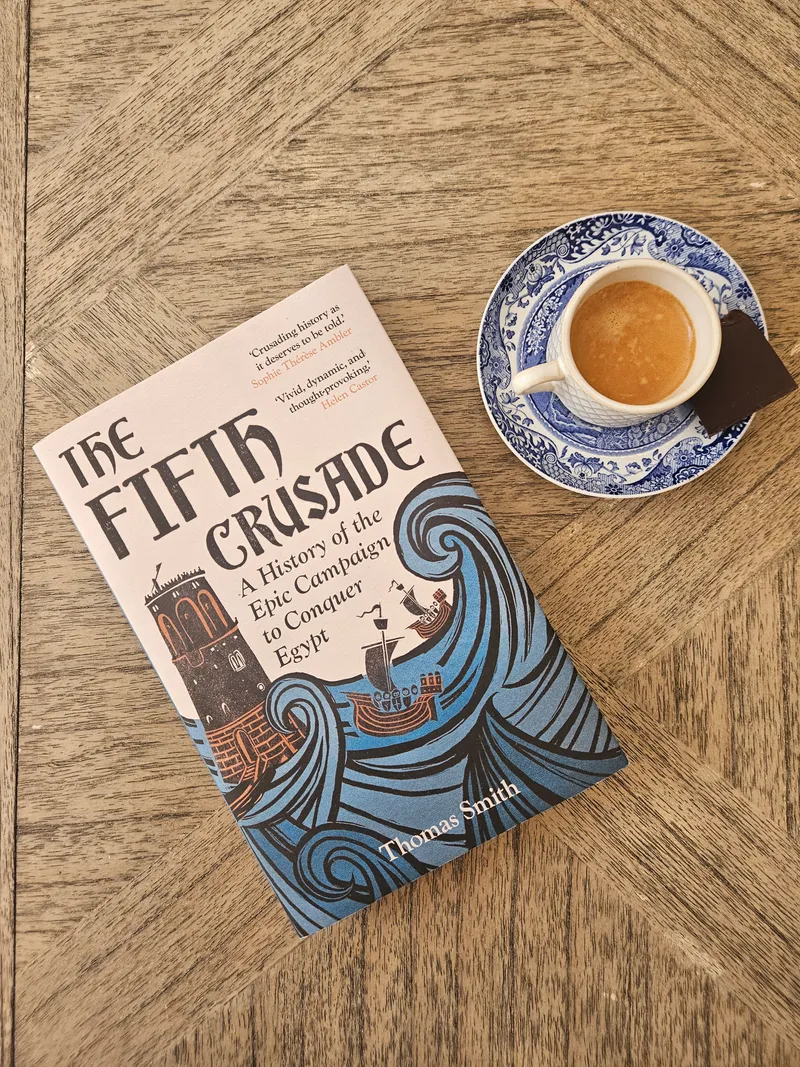
Thomas Smith’s new book, The Fifth Crusade: A History of the Epic Campaign to Conquer Egypt, is the story of one of the more overlooked crusades. And yet, as Smith makes clear from the opening pages, this is one of the most intriguing of them. The Fifth Crusade (1217–1221) was an attempt not to recapture Jerusalem directly, but to conquer Egypt, the wealthy “breadbasket” of the Islamic world, as a stepping stone to the Holy Land. Things did not go to plan for the crusaders, however: disputes over leadership, poor planning, plus floods and disease, quickly showed them that this would be a much harder undertaking than they assumed. Greek fire, the incendiary weapon used by the Muslims, didn’t help, either.
Drawing on both Christian and Muslim sources, which gives the narrative depth and balance, Smith makes the case for why this story is worth studying. Geopolitically, it reshaped the Mediterranean. Socially, it affected thousands of lives. (And the book is careful to include voices beyond those of kings and knights wherever possible.) But it is culturally, perhaps, that the Crusades are still so relevant today. The binary model of a “clash of civilisations” is still used in contemporary discourse and, just like in the medieval world, it doesn’t really hold up to scrutiny. Smith argues that medieval alliances were messier than we tend to assume, and that is something we would do well to keep in mind when thinking of today’s world, too.
What I loved most about the book were the unexpected stories. Jacques de Vitry (d. 1240), the bishop of Acre, and the historian Ibn al-Athir (1160–1233) may be some of the most important sources in this study, but there are plenty of other vivid characters in the Fifth Crusade. Like the fighter from Bologna who left a detailed will, worried about how his wife would fare after his death. Or like Saint Francis of Assisi, who, in 1219, crossed enemy lines outside Damietta to meet Sultan al-Kamil in person, hoping to convert him to Christianity. I don’t need to tell you that he didn’t succeed.
If you come to this book expecting a straight military narrative, you will find something more interesting: a story about why people do extraordinary and terrible things, and how quickly plans can unravel. But also, how creative humans can be (the floating devices created by the crusaders for the siege of Damietta were one of my highlights in this book). The history of the Fifth Crusade is handled with the combination of scholarly care and narrative energy it deserves. Smith is alert to the religious dimensions of the crusade, the politics of the papacy, and the extraordinary mix of personalities (kings, cardinals, prophets, and saints) who ended up in Egypt for reasons they might have struggled to fully articulate.
And then there are the women. I was so pleased to find female crusaders in this book! Women supported the Crusades in many ways, and Smith is careful to include their commitment to the crusading efforts in his narrative:
Female crusaders are massively under-represented in the surviving source material for the simple fact that most accounts of the crusade were written by clergy, who were interested in the martial deeds of other men. […] women in fact played crucial auxiliary roles in the Fifth Crusade at important junctures in the campaign. (p. 43)
Women carried stones, provided warriors with food and water, tended to their wounds, and, sometimes, fought. I only wish there were more primary sources telling their stories.
One of the things I found most thought-provoking was Smith’s treatment of the crusade’s ultimate failure. It collapsed for reasons that feel almost embarrassingly familiar: miscommunication, ego, uncertain funding, and a failure to understand the terrain.
For readers whose knowledge of the crusades begins and ends with Richard the Lionheart, The Fifth Crusade is an excellent reminder that the story is far longer, stranger, and more human than the popular imagination tends to allow, and it involves far more characters. If my dear Monsieur Roche were still alive, I would send him a copy in a heartbeat.