Have you ever wondered where the word ‘Easter’ comes from? Let me introduce you to the Germanic goddess of dawn and spring, Eostre, after whom Easter was possibly named. (Historians and folklorists are still debating this, largely due to the paucity of sources about her.) Like many other Anglo-Saxon deities, Eostre was a victim of the expansion of Christianity, as pagan gods were replaced with the monotheistic religion. Yet in the twentieth century, modern paganism rediscovered her, with one of the eight Wiccan festivals (or Sabbats) being celebrated in her honour. Eostre was reinvented to fit a New-Age kind of religion, linked to the spring equinox, with myths and traditions from different origins blending to create a syncretic goddess of rebirth. Let’s investigate.
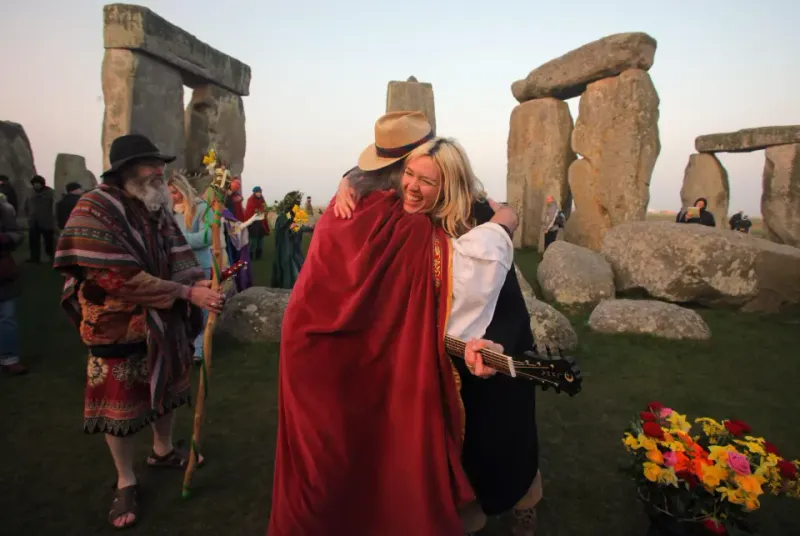
Wiccans celebrating Eostre at Stonehenge in the 2020 spring equinox. (Credit: Getty Images)
Bede’s Clue: A Goddess in a Calendar
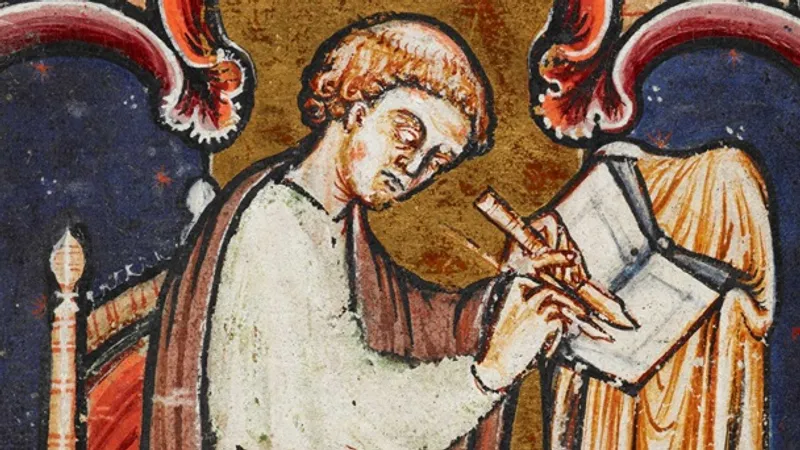
Unfortunately, because the Anglo-Saxon culture was largely oral, this means there are few primary sources to work with to find out more about her. A seventh-century Christian monk called Venerable Bede provides a clue. He lived in Northumbria (in modern-day England) and is considered the ‘father of English history’. In his work De Temporum Ratione (The Reckoning of Time), written around 725 CE, Bede set out to explain the Anglo-Saxon calendar to his fellow monks. His goal was practical: he wanted to help the Church calculate the correct date for Easter. But in doing so, he left us with the only contemporary written reference to the goddess.
Venerable Bede writes of how Eostre was losing her place to the Christian holidays, themselves influenced by the Jewish tradition (Paschal comes from the Jewish Pesach or Passover). According to him, the month of April used to be called Eosturmonath (month of Eostre), since this is when the spring goddess would be worshipped:
Eosturmonath has a name which is now translated as ‘Paschal month’ [Easter month], and which was once called after a goddess of theirs named Eostre, in whose honour feasts were celebrated in that month. Now they designate that Paschal season by her name, calling the joys of the new rite by the time-honoured name of the old observance.
— (Venerable Bede, The Reckoning of Time)
Portrait of Venerable Bede writing, from a 12th-century copy of his Life of St Cuthbert. (Credit: British Library)
Now, some scholars have questioned whether Bede was simply explaining a word he found in the calendar, or whether he had real knowledge of a living cult. After all, by his time, England had been officially Christian for over a century. Was Eostre still worshipped, or was she already a fading memory, preserved only in the name of a month? We simply don’t know. But what we do know is that Bede was a careful scholar, not given to invention, and he presented Eostre as a matter of fact. That single passage is essentially all we have from the period. And yet, it was enough.
A Thousand Years of Silence, Then Grimm
The problem is that, following this text, I can hardly find anything about the goddess for more than a thousand years. The next mention of her (Ostara) is in the nineteenth century, in Jacob Grimm’s 1835 Teutonic Mythology, in which he writes of an oral tradition of her worship. Like his brother Wilhelm, Jacob was fascinated by myths and folklore, which is why they compiled the popular Grimm’s fairy tales. But Jacob Grimm was also a serious philologist, and in Teutonic Mythology he attempted something ambitious: to reconstruct the lost mythology of the Germanic peoples by tracing linguistic and cultural clues across different regions.
Jacob Grimm linked the Germanic goddess Ostara to the Anglo-Saxon Eostre, as she also had the month of April named after her: Ostermonat, or month of Ostara. He noted that in parts of Germany, popular customs associated with Easter, such as lighting bonfires on hilltops, could be traces of older pagan celebrations. This is how he described her:
‘Eostre seems therefore to have been the divinity of the radiant dawn, of upspringing light, a spectacle that brings joy and blessing, whose meaning could be easily adapted by the resurrection-day of the Christian’s God.’
He added:
This Ostara, like the [Anglo-Saxon] Eostre, must in heathen religion have denoted a higher being, whose worship was so firmly rooted, that the Christian teachers tolerated the name, and applied it to one of their own grandest anniversaries.
— (Jacob Grimm, Teutonic Mythology)
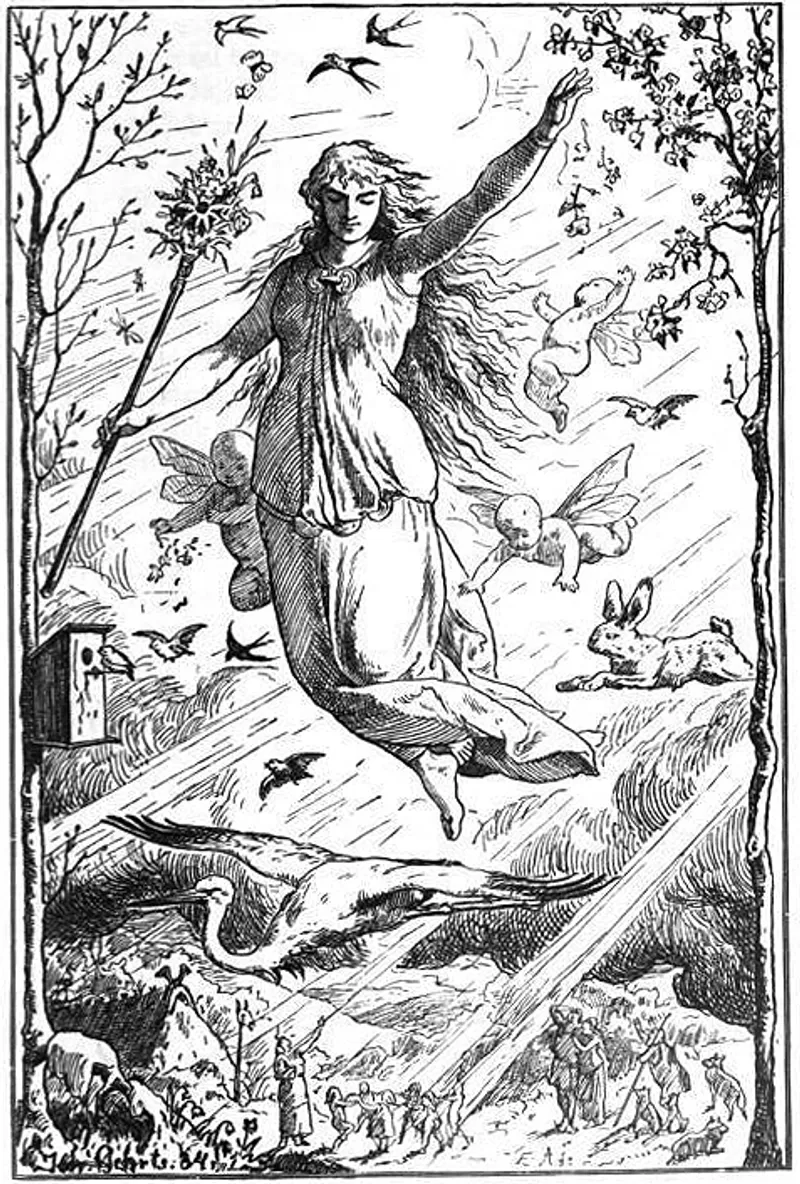
Ostara (1884) by Johannes Gehrts.
Now, it’s worth noting that Grimm’s methods have been criticised. He was working in the Romantic tradition, and some scholars argue that he was a bit too eager to reconstruct a coherent Germanic mythology from scattered fragments. I think that’s a fair point, but his connection between Eostre and Ostara remains influential to this day. And the painting above, by Johannes Gehrts, shows how quickly the idea captured the popular imagination. Within decades of Teutonic Mythology, artists were already depicting Ostara as a radiant figure surrounded by the symbols of spring. Not bad for a goddess with almost no historical record.
Easter, Eggs, and Borrowed Traditions
It would make sense to choose a date to symbolise Christ’s resurrection at a time when people were already celebrating the idea of rebirth. Yet it was important to separate the Christian Easter from the Jewish Passover, as established in the Easter controversy of the 325 CE Council of Nicaea. Moreover, symbols that we came to associate with spring and Easter, such as eggs and bunnies, which developed independently from the worship of Eostre, are all connected to fertility, rebirth, spring, and life. Our contemporary Easter is a mosaic of different traditions. The same can be said of the association between Eostre and dawn (probably from the old High German ‘dawn’, eostarum), and the idea of the cycle of life. The theme of rebirth fitted perfectly in all of this: Christ’s sacrifice is followed by his resurrection, just like nature comes back to life in spring following the wintertime.
Take the Easter egg, for instance. In medieval Europe, eggs were forbidden during Lent, so they accumulated and were decorated and given as gifts when Easter arrived. The Easter hare (later the Easter bunny) appears in German Lutheran texts from the seventeenth century, where children were told that a hare would lay coloured eggs for those who had been good. I love this image, by the way: a hare laying eggs. None of this has anything to do with Eostre specifically, but over time, these traditions became tangled together in the popular imagination, creating the impression of a single, ancient spring festival. History can be a bit like a game of telephone sometimes.
Christianity is well-known for appropriating elements from other, earlier faiths, like many religions. Partly, this was a tactic for easing people into the new faith, as they could keep some practices or rituals. For instance, in 595 CE, Pope Gregory sent missionaries to modern-day England in the hope of converting people to Christianity, advising them to allow many festivals and rituals to remain, while adding Christian meanings to them. It is possible that the Christian Pascha was assimilated to Eostre’s festival in the hope of converting people away from their old religion and into Christianity. Because of the lack of primary sources, it is difficult to know. It is likely that Eostre was a localised goddess worshipped by the Anglo-Saxons in present-day England, who may have been connected to Ostara.
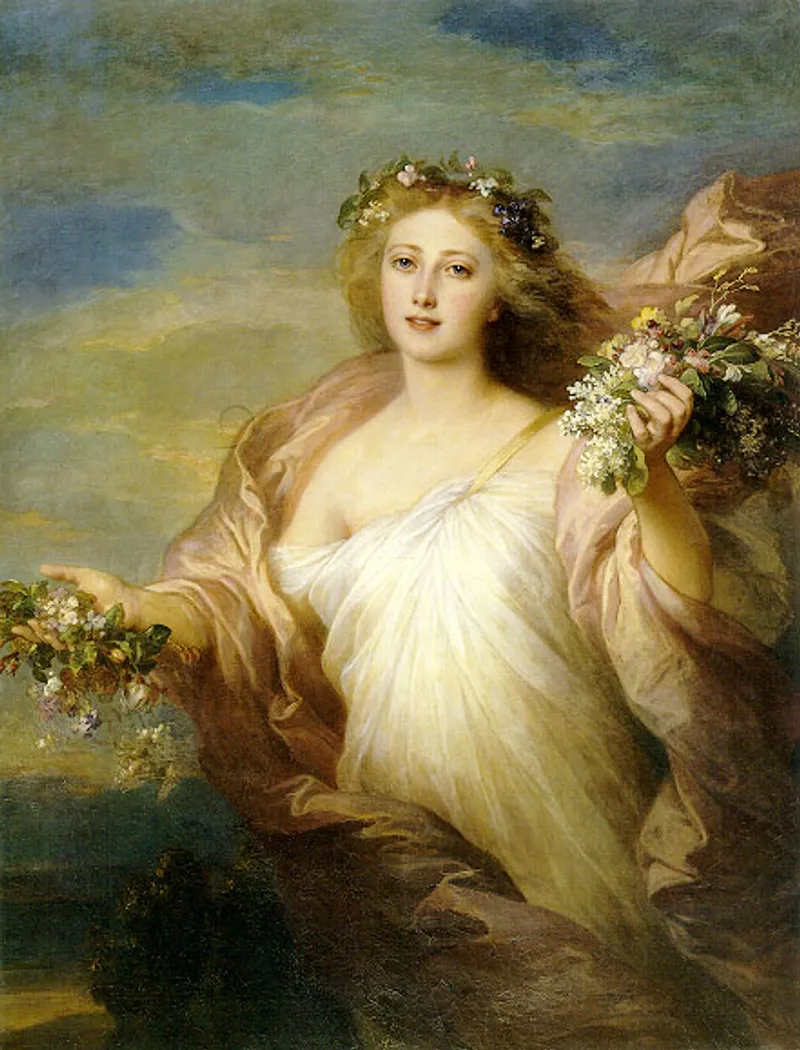
The Spring (1851), by Franz Xaver Winterhalter. (Wikimedia Commons)
Eostre Reborn: From Grimm to Modern Wicca
Frustrating as it might be for historians, we simply don’t have enough sources to know for sure. Yet I find it fascinating how, following Jacob Grimm, modern Wiccans have adopted Eostre and made her their own. In the Wiccan Wheel of the Year, which was formalised in the mid-twentieth century, the spring equinox sabbat is often called Ostara. It celebrates the balance between light and dark, the return of warmth, and the fertility of the earth. Rituals may involve planting seeds, decorating eggs, and honouring the goddess of dawn. Now, much of this is modern invention, drawing on a mix of Celtic, Norse, and Germanic traditions, but I think that is rather the point.
Is that so different from early Christianity adopting elements of other religions to build their own faith? I don’t think so. In this syncretic narrative about Eostre, elements of her ancient cult remain: many of us still celebrate Easter every year, even if it is in connection to another religion. Or, really, no faith at all. Some of us just want to celebrate spring and nature coming back to life, a reminder of our own possibilities of recreating and reinventing ourselves. Others just want an excuse to decorate the house with cute bunnies and eat chocolate eggs. Who am I to judge? Indirectly, we keep the goddess Eostre alive, by creating our own traditions and myths. Plus, which deity would have objected to eating a few chocolates…?
References
Venerable Bede, De ratione temporum/The Reckoning of Time, translated by Faith Wallis (Liverpool: Liverpool University Press, 1999).
 Dr Julia Martins