Discussion of issues related to violence, murder, and suicide
Some persistent myths haunt historians. One of my personal pet peeves is the idea that Julius Caesar was born through a caesarean section. The name Caesar supposedly came from the cut maternal uterus: caesomatris utero, in Latin. Which doesn’t make any sense. The main reason for this is that, until quite recently (late 17th century, at the earliest), caesarean sections were not performed in Europe until the pregnant person was dead. They were called sectioin mortua, literally the ‘cutting of the dead woman’. And we know that Caesar’s mother, Aurelia, lived for decades after she gave birth to him. Yet giving birth in ancient times was still a dangerous affair.
So… No caesarean section in Caesar’s case. But why did people believe that Julius Caesar had been born in this fascinating way for so long? Caesar’s birth story has been retold for centuries. For instance, in a 15th-century manuscript preserved in Florence, a reader interested in Caesar’s birth could learn that
… He was called Caesar because his mother died before he was born, and she was cut open, and he was pulled alive from her body.
— Brief History of the Roman Emperors (Florence, 1479).
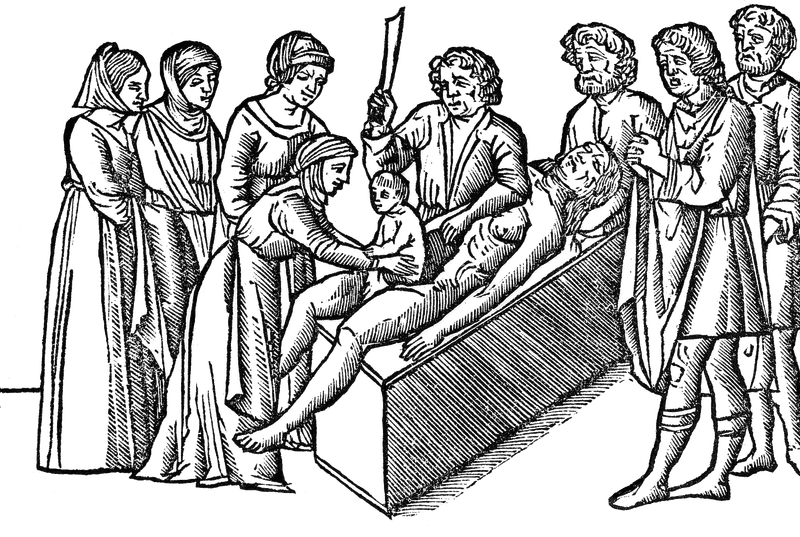
There were many similar retellings of this famous birth in manuscript form and, from the 16th century onwards, in print.
A midwife welcomes Julius Caesar into the world after the surgeon had cut open his mother in Suetonius’ De vita duodecim caesarum, 1506. Credit: Wikimedia Commons.
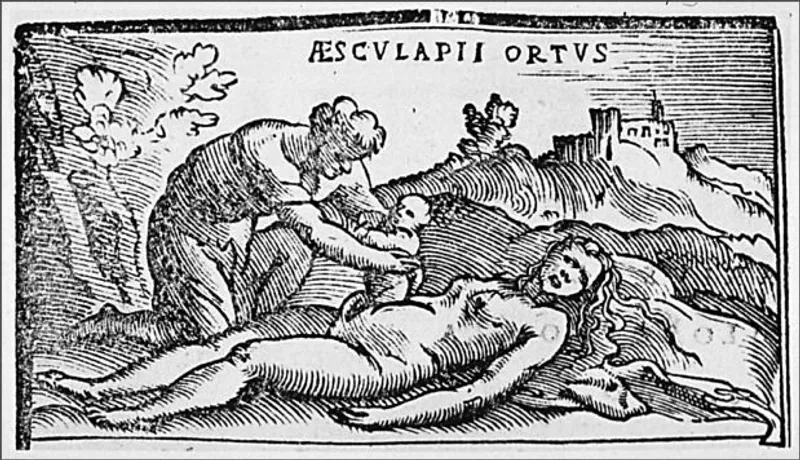
There is no evidence (that I know of) that caesarean sections were performed in ancient Rome. There was a period during which Roman law required babies to be extracted from their mother’s womb if she died in childbirth so that they could be buried separately (the infant rarely survived), but these were uncommon occurrences. However, that may be precisely why such a unique and mythic birth would be attributed to Caesar, who was understood as the heroic founder of the Roman empire. Nor was Caesar the only Roman whose caesarean delivery fascinated people. As Ovid wrote in his Metamorphoses, Asclepius (the god of medicine) was born in a similar way. His father, Apollo, had fallen in love with the nymph Coronis, whom he impregnated and later killed in a fit of jealousy. Regretting his crime immediately, Apollo decided to cut the nymph’s body open and save their baby. The remorseful father became a surgeon, symbolising Asclepius’s connection to medicine (and, indeed, Apollo’s).
Apollo delivers Asclepius in Alessandro Benedetti’s De Re Medica, 1549. Credit: U.S. National Library of Medicine
Both Caesar and Asclepius’ births were retold through the centuries, but a common narrative aspect of these births was how auspicious they were. These men didn’t depend on their mothers: the mother acted as a vessel to the baby, having no active role in its delivery. (Or after that, as caesarean sections implied the mother’s death.) Yet what made a good midwife in later periods involved recognizing the mother’s agency and role in birth.
Julius Caesar’s birth story was entangled with the story of the birth of the Roman empire, which symbolically started with the opening of the maternal womb. In many of these retellings, this is also how the empire’s story ended, too. With Nero, the end of the lineage was symbolised by another opened womb: his mother’s. In the same Florentine manuscript in which Caesar’s birth was described, it was written that
… He [Nero] had his mother killed to see where he had been, so he had her opened. […] Then he ordered the philosophers to make him pregnant so that he could have a son who resembled him, as he doubted his wife would bear him legitimate children. The philosophers did so by putting a frog inside his body.
— Brief History of the Roman Emperors
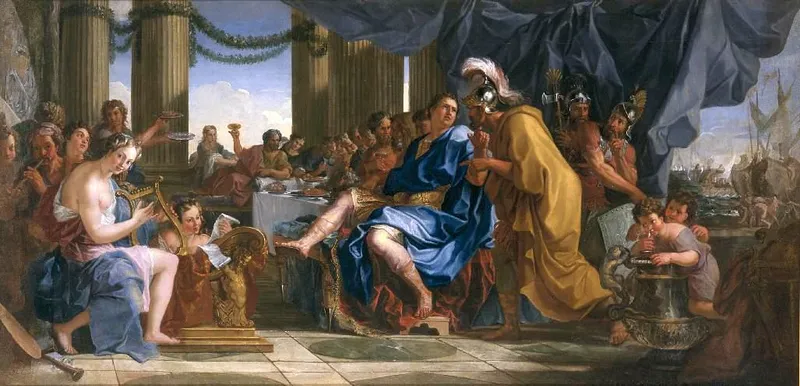
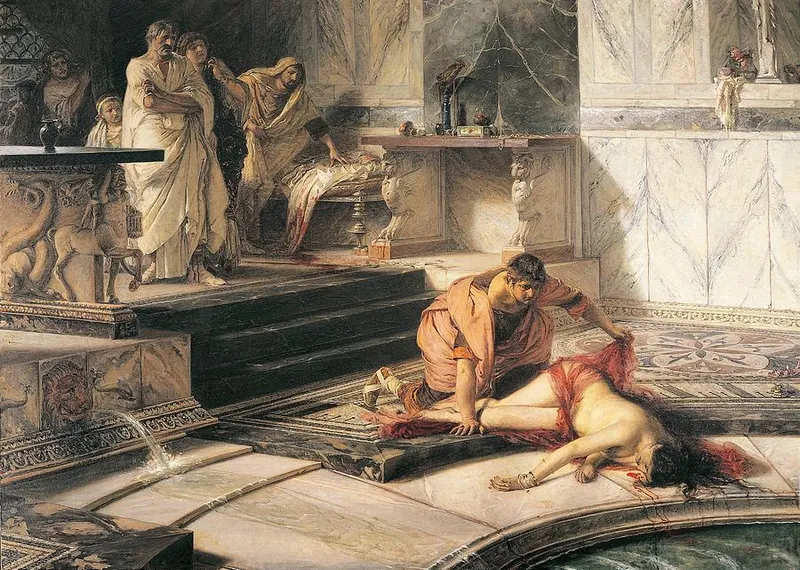
Nero was so intrigued by pregnancy that he had his mother, Agrippina, eviscerated and her womb inspected. His project of becoming pregnant himself not only ensured his paternity but also eliminated women from the dynastic conversation altogether.
Nero Ordering the Murder of his Mother by Noël Coypel I, 17th century. Credit: Wikimedia Commons
In the 13th-century Golden Legend, writer Jacobus de Voragine added that, after physicians had told the emperor that his mother’s murder and dissection and his impregnation were unthinkable, Nero threatened to kill them, and the physicians conceded. So, they made him a drink containing the frog mentioned above. They gave it to the emperor, and the frog grew in Nero’s belly, with the emperor thinking he was carrying a baby. Finally, he couldn’t stand the exhaustion of pregnancy anymore and begged his physicians to end it. They made him vomit, giving birth through the mouth, and out came ‘a frog horrible to see, covered in evil humours and blood’. Nero committed suicide, his maternal evisceration and subsequent pregnancy symbolising imperial decadence and wickedness.
Nero unveils the female body’s secrets by inspecting his mother’s corpse. Antonio Rizzi, 19th century. Credit: Wikimedia Commons.
For people reading these texts in the late medieval and early modern periods, the mirroring stories of Nero and Caesar would be familiar. The Roman Empire began and ended with an opened womb: Caesar’s tale was a heroic model, while Nero’s fate was a cautionary tale. Written in the vernacular, these descriptions of Roman history circulated widely. Caesar’s mother was a good woman: she lived and died to give birth to her husband’s heir. Aurelia was a model of sacrificing the (female) individual to the (male) collective. Nero’s mother, Agrippina, didn’t even have a voice in most of these texts: she was a tragic victim of her son’s folly.
However, in both cases (as well as in the story of Asclepius’ birth), these opened wombs constituted a common motif in visual arts, from paintings to the decoration of homes and furniture, especially in Northern Italy. But why?
It’s no coincidence that Caesar’s birth appeared in so many manuscripts in early modern Florence. This mythical Roman history was crucial to shaping Florentine nobles’ aristocratic values and identity. Other stories in which male agency and power forced female submission (such as the rape of the Sabine women) were commonly used to decorate homes and reinforce patriarchal values.
Regardless of *what really happened* in Ancient Rome (another expression historians usually hate), these unique stories could fascinate, shock, and entertain centuries later: but we can argue that they also served to remind people (and especially women) of the ‘natural’ order, with women subjugated by men. Whether it was Caesar’s moral tale of feminine sacrifice, Nero’s horrific story of matricide and unnatural ‘self-impregnation’, or Asclepius’ destiny to become a divine healer, these stories had in common powerful, alive men and disempowered, dead women.
*All translations are my own.
References:
Jacobus de Voragine, The Golden Legend (London: 1470).
Philippa Bright and Diane Speed (eds), Oxford Medieval Texts: The Anglo-Latin Gesta Romanorum: from Oxford, Bodleian Library, Douce MS 310 (Oxford: 2019)
Brief History of the Roman Emperors (Florence, BNCF, ms. Palat. 471: 1479).
Ovid, Metamorphoses (Oxford: 2004) edited by R. J. Tarrant.
Further reading:
Katharine Park, Secrets of Women: Gender, Generation, and the Origins of Human Dissection (New York: 2006).

 Dr Julia Martins